
In the ever-evolving digital age, information security is paramount for businesses and organizations. Organizations must protect their customers’ data and intellectual property, and ISO 27001 can provide them with assurance of safety.
As a widely accepted and recognized Information Security Management Standard, the successful completion of an ISO 27001 certification process indicates an organization’s commitment to information security globally. Moreover, achieving ISO 27001 certification is an effective way for organizations to prove that their operations are correctly managing and protecting sensitive information.
Businesses today face a critical issue of data security and intellectual property security, and ISO 27001 certifications serve as badges of trustworthiness. By demonstrating such a commitment to the security of customers’ data and intellectual property, organizations can gain a competitive edge in the market. This will foster customer loyalty. Moreover, such certification is a sign of competent governance. This eases customers’ worries about data possession and makes them feel more confident about using a particular organization’s services.
Gaining ISO 27001 Certification
The pursuit of ISO 27001 Certification is a rigorous process, involving several components that must be carefully considered and implemented for successful certification. ISO 27001 Certification includes Risk Management Framework, Gap Analysis, Risk Assessment, and Incident Management.
At its core, the Risk Management Framework is a systematic process that allows businesses to identify potential risks that could lead to an information security incident. This includes recognizing threats and vulnerabilities and creating a plan of action to mitigate risks. After a risk has been identified and assessed, appropriate security controls can be implemented to reduce the risk to a tolerable level.
Gap Analysis
Gap Analysis is a crucial element of ISO 27001 Certification. It involves understanding the differences between current and desired information security levels. During this process, an analysis of existing controls is conducted to identify areas where they are positioned to prevent information security incidents. Businesses can identify and rectify any gaps in security controls.
Risk Assessment
Risk Assessment is a critical step in ISO 27001 Certification. It entails objectively evaluating the risks associated with all areas of information security. This involves establishing criteria for classifying the risk. It also involves analyzing the threats and vulnerabilities in the system and assessing the implications and impacts of the identified risks. Risk assessment is an integral component of ISO 27001 Certification. It is an essential tool for organizations to understand their security posture and identify areas where improvements can be made.
Finally, Incident Management is an integral step in ISO 27001 Certification. It entails having an effective framework in place, which can respond quickly to an information security incident. Incident management systems should enable organizations to quickly identify, investigate, and respond to incidents. Additionally, it should also enable organizations to take the necessary measures to protect their information assets’ confidentiality, integrity, and availability.
Organizations’ success in their pursuit of ISO 27001 Certification depends on implementing all of the key components mentioned above. Security controls, risk management frameworks, gap analyses, risk assessments, and incident management systems must all work together to create an effective and secure environment. By adopting all of the necessary components and procedures outlined by ISO 27001, organizations can be assured that their information assets remain secure. In addition, they can comply with all legal and industry regulations.
The Certification Process
Reaching ISO 27001 Certification is a long and challenging journey and requires attention and commitment from all key stakeholders. Generally, the process involves extensive auditing of the Information Security Management System (ISMS) and compliance tests against industry best practices and standards. This includes audits of an organization’s Compliance Regulations, SOC 2 Audit, and PCI DSS Compliance.
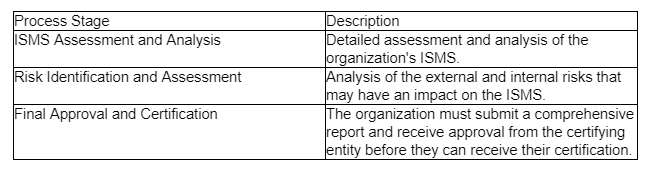
The entire certification process can be broken down into multiple stages. The organization’s ISMS must be assessed and analyzed in detail during the initial phase. This includes documenting how the organization will meet the ISO security requirements. The organization must also create and implement appropriate controls and procedures to ensure that the system meets the required standards.
Furthermore, the ISMS must be evaluated and tested in multiple ways, including a detailed audit of the Compliance Regulations, SOC 2 Audit, and PCI DSS Compliance. This ensures that the system is designed to meet all security and regulatory requirements. This involves conducting thorough tests and reviews of the system’s functionality and security features. It also includes implementing and monitoring necessary measures to ensure system performance and appropriateness.
Risk Identification and Assessment
Once the organization’s ISMS has been implemented and tested, the next step is to identify and assess any risks posed to the system. This involves an analysis of both external and internal threats that could impact the organization and its information systems.
Following this, the organization must determine the appropriate controls and procedures that need to be in place. This is to ensure that they are adequately equipped to protect against potential risks. This includes ensuring that the system is adequately protected from unauthorized access or malicious actors, as well as hacking or malware threats.
Final Approval and Certification
Upon completion of all the necessary tests and reviews, the organization must submit a comprehensive report outlining its plans for protecting the ISMS and its associated data. Once the report has been reviewed, organizations must receive final approval from the certifying entity before they can be awarded ISO 27001 certification. Finally, periodic reviews must be conducted to ensure that the system complies with the standard requirements.
ISO 27001 Certification: A Powerful Tool to Strengthen IT Governance
ISO 27001 certification provides many advantages for businesses, including improved customer trust, data protection, and a competitive edge. When an organization achieves ISO 27001 certification, it signals to the world that they take IT infrastructure seriously. They have implemented strong measures to protect private data. Companies that are certified with ISO 27001 gain higher levels of customer trust and demonstrate their teams’ expertise and dedication to customer information security.
With ISO 27001 certification, businesses can proactively protect their digital assets due to the rigorous certification framework. This framework includes identifying and assessing risks to data and systems. It also establishes an effective IT governance model and develops strong internal controls for critical assets. As these procedures are implemented, businesses can be confident that their digital infrastructure is safe from a wide range of threats. This efficient and effective system reduces the time and cost associated with mitigating risks.
Alongside ISO 27001’s structured risk identification and IT governance controls, organizations are increasingly turning to Data Security Posture Management practices to strengthen their overall security foundation. DSPM provides continuous visibility into where sensitive data resides, how it is protected, and where exposure risks may exist across cloud and on-premises environments. This ongoing posture assessment complements the ISO 27001 framework by translating its governance principles into actionable, real-time intelligence — a combination that not only reinforces operational security but also positions businesses more firmly to meet the regulatory compliance obligations addressed in the sections that follow.
Compliance with regulations is one of the most important benefits businesses gain from this certification. Regulatory boards often require organizations to demonstrate sufficient measures to protect user data, making certification a key requirement. ISO 27001 also helps to ensure compliance with applicable international standards in countries across the globe.
Complementing ISO 27001 certification, organizations are increasingly turning to dedicated consent management solutions to reinforce their regulatory compliance posture. privacy protection and compliance through consent platforms has emerged as a strategic discipline in its own right, enabling businesses to document user consent systematically, satisfy obligations under GDPR, CCPA, and similar frameworks, and demonstrate accountability to auditors and regulators alike. This structured approach to consent not only closes potential compliance gaps left unaddressed by certification alone, but also signals to customers that their data is handled with transparency — a distinction that carries measurable weight in competitive markets.
Finally, certification can provide businesses with a competitive edge in the marketplace. Consumers are increasingly concerned about the security of their data. Businesses that are certified demonstrate their commitment to protecting their customers’ personal data and information. As more organizations pursue ISO 27001 certification, those that have achieved it can gain an advantage in the eyes of customers. They can set themselves apart from the competition.
Achieving ISO 27001 Certification is a journey that, while daunting, is worth undertaking. Organizations gain many benefits after achieving certification. By investing in this certification, organizations can succeed in the digital economy.
From the implementation of stringent data security measures to the assurance of procedural and technological proficiency, obtaining ISO 27001 certification is a statement of commitment and dedication to an organization’s present and future security. For those brave enough to embark on this arduous yet beneficial journey, success awaits. Ultimately, with the right set of tools and strategies, sound decision-making, and a commitment to excellence, an organization can obtain the certification that allows it to surpass its competition and protect the vital assets and sensitive information it holds dear.

Terry Fogg is a seasoned software developer and agile methodology enthusiast. With over a decade of experience in the tech industry, Terry brings a wealth of knowledge in innovative software solutions. Passionate about sharing insights and fostering learning, Terry’s articles offer practical advice and fresh perspectives on the evolving world of software development.